

Many clinicians already use ChatGPT, Claude or OpenEvidence between patients. The answers come back fluent and confident, and often generic. That isn't a flaw in your prompting skill so much as a gap in what the model knows. As Tim Oates, PhD, Chief Data Scientist at Synaptiq, put it in our recent webinar, the model "has read more medicine than you have, and that is not a knock on anybody here." But "it hasn't seen a patient, and it hasn't seen your patient."
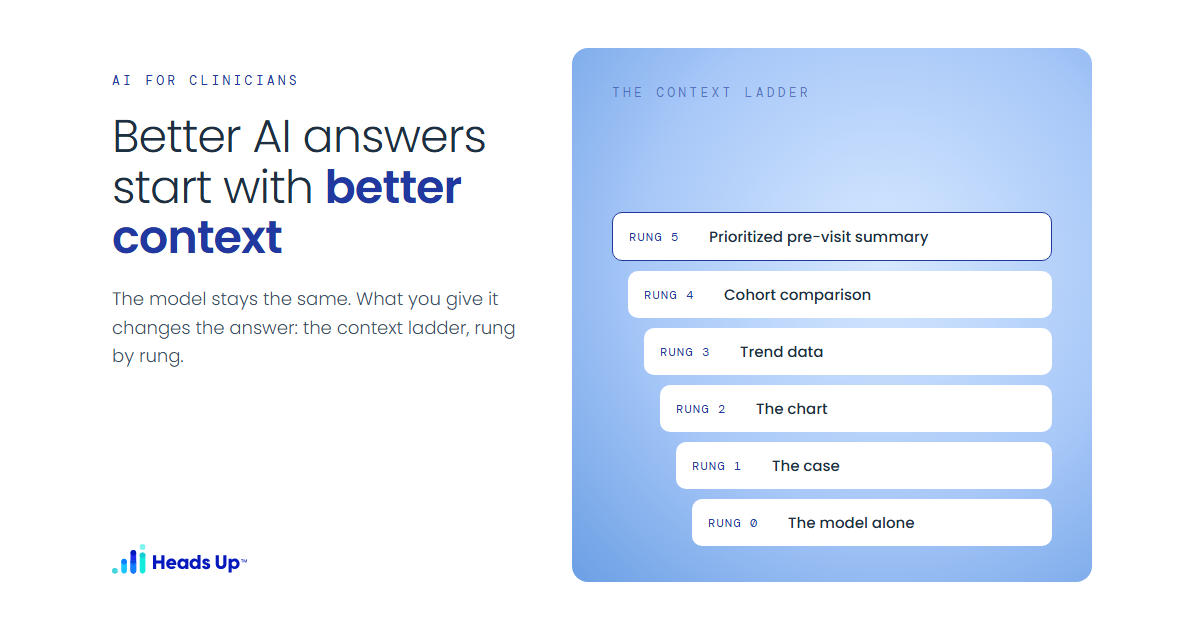
In that webinar, The Clinician's Guide to AI, Tim offered a useful way to think about AI for clinicians: the model stays the same, and what changes the answer is the context you give it. He called it a ladder. Each rung adds context, and each rung gets you a more grounded answer. This guide walks through the rungs, the habits that keep AI honest, and where the line sits between what AI should do and what clinicians decide.

What an LLM is actually doing, and why context matters
A large language model predicts the next word. It doesn't look up a "right answer"; it estimates which words are most likely to come next, given everything before them.
Tim illustrated this with a simple demo. Train the same model on the same recipes, but let it condition on one previous word instead of two. With one word of context, the output is nonsense. With two, it starts to read like a real recipe. Nothing about the model changed. Only the context did.
That's the whole idea behind the ladder. In a clinical setting, as Tim put it, the document is the patient: the more of the real case the model can see, the less it has to fill in with averages.
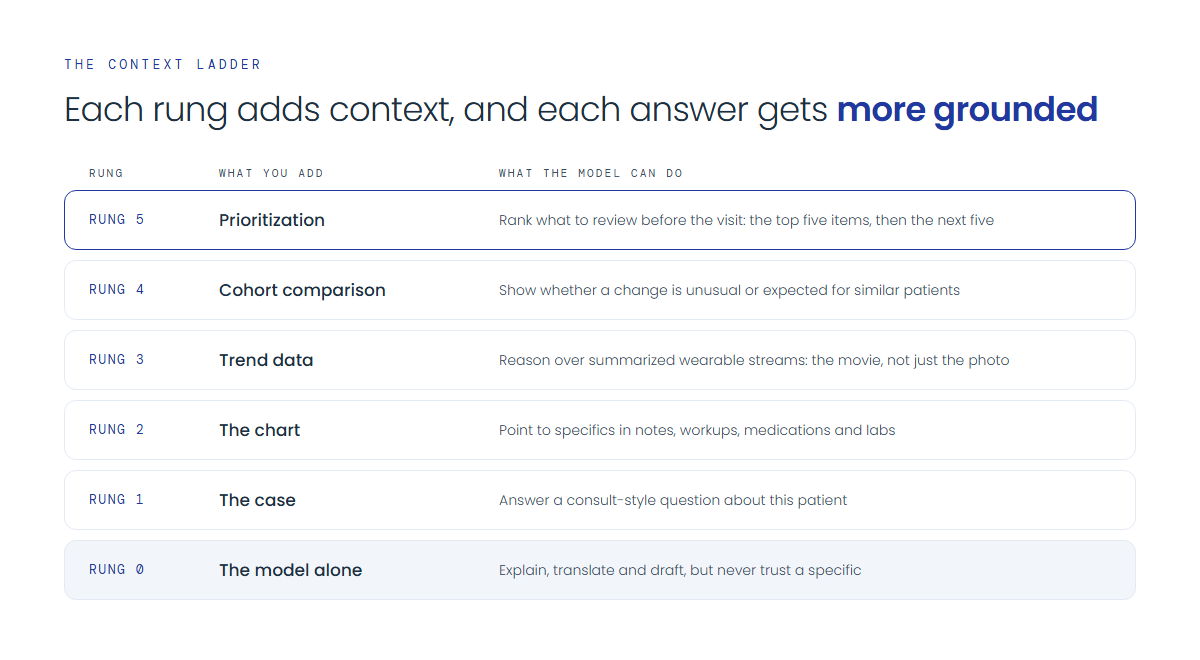
The context ladder: five rungs of AI for clinicians
- Rung 0: the model alone
- Rung 1: add the case
- Rung 2: hand it the chart
- Rung 3: add trend data
- Rungs 4–5: compare against a cohort, and prioritize what to review before the visit
0
The model alone — explain, translate, draft
With no patient context, an LLM is still useful. It can explain a mechanism, lay out the trade-offs between two approaches, reword a care plan in patient-friendly language, or draft a letter.
Tim's rule for this rung is simple: "when you're sitting at rung zero, you should never trust a specific." As he put it: "You don't trust numbers. You don't trust citations. Clearly, you're not gonna trust doses that it's mentioning." Fabricated citations are a good example of why. A made-up reference looks right because it is statistically likely: plausible authors, a plausible journal, a plausible year. Tools that can search the web reduce this risk, but they don't remove it. Verify every specific against a primary source.
1
Add the case, and write the prompt like a consult request
This is the rung that pays off fastest. In Tim's words, "the prompt, the thing that you say to the LLM is in some sense a request for a consultation." Write it the way you'd brief a colleague you respect.
Checklist: a consult-style prompt
- Who the patient is (age, sex, relevant history; no identifiers in a general-purpose tool)
- The specific question you want answered
- What's already been done or ruled out
- What you need back
- The format and length you want
- The evidence behind each point
- What information would change the answer
That last item is the one Tim singled out: "tell me what information, if you knew it, might change your answer. And that is unbelievably powerful." Asking the model what it doesn't know surfaces the gaps in its reasoning. Dave Korsunsky added two variations from his own use: ask for three reasons the working thesis could be wrong, or ask what one more data point would change.
Synthetic example (not a real patient):
A 52-year-old woman in a longevity program reports eight weeks of fatigue and poor sleep. Labs from three months ago: ferritin low-normal, TSH within range, fasting glucose normal. She started a new supplement stack six weeks ago. Question: what are the most likely contributors to her fatigue, and what should I check next? Give me no more than five points, ranked, with the reasoning for each. Then tell me what information, if you had it, would change your answer.
2
Hand it the chart, not your memory of it
At some point, typing a summary of the case becomes the bottleneck. The next step is to stop typing and give the model the record itself: notes, prior workups, medications and labs.
That's harder than it sounds. "Now the tools are so unbelievably powerful that the hard part is actually getting the data to them," Tim said. As Dave put it, "a lot of this data is still sitting inside PDF files inside of the EHR system." AI is now good at pulling that data out into clean tables, but someone has to get the documents to it.
Grounding changes the output. In the webinar's synthetic case, once the model could see the chart, it pointed out specifics a summary would have missed, such as a repeat ferritin that was planned but never drawn, and a medication list that no longer matched a recent patient message.
Be honest about the limits here, too. As Tim warned, "if you don't include something, it's invisible." Old data reads as current unless it's dated. And the chart is not the patient: it's a record of what someone wrote down.
3
Trend data — a lab is a photo, a wearable is a movie
Tim's analogy for this rung is a good one. Think of "a lab result as a photograph, it's like, boom. Here's what was going on, you know, on Tuesday morning. Wearable data is a bit like watching a movie."
Raw wearable streams are too large and noisy to hand to a model directly. Summarize them first, using nightly averages, weekly averages or rolling windows, and then let the model reason over the summaries. Every summary choice shapes what the model can see. A weekly average smooths out the nights that matter; a seven-day window may hide a slow drift. Choose deliberately, and note your choice.
In the webinar's synthetic case, HRV and sleep efficiency had been declining since June, while the patient only reported feeling worse in August. Reviewing the trajectory since the last visit put that change in front of the clinician at the next review, with the data to support the conversation.
4–5
Cohort comparison and a prioritized pre-visit summary
The top rungs add perspective. Comparing a patient against similar patients in your own panel shows whether a change is unusual or expected for that population.
The final rung is prioritization. Ask the model for the five most important items to review before the visit, then the next five, and stop when the items start to feel like noise. A ranked, pre-visit summary turns a long record into a short agenda. The clinician still decides what matters.
Three habits that keep AI honest
- Talk it through. Treat it like a Socratic dialogue, the way you'd work a case with a colleague, rather than writing one enormous prompt and accepting what comes back.
- An articulate answer is not evidence. "Just because the reasoning is articulate, that's not evidence," Tim said. A well-written reasoning trace can be confidently wrong, so pressure-test answers that sound sure of themselves.
- Keep a path back to the source. Every point the model makes should link to the note, lab or data it came from. In Tim's words: "So human oversight is not optional."

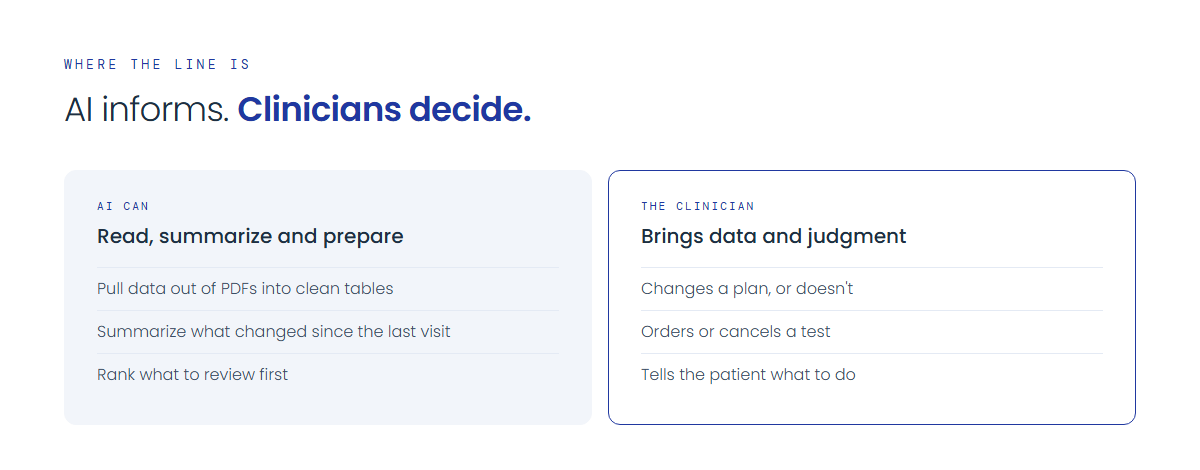
Where the line is: AI informs, clinicians decide
AI can read, summarize and prepare. Tim was direct about where it stops: "you're not changing a plan. You're not canceling an order. You're never gonna tell a patient what to do."
Tim Oates, PhD, Chief Data Scientist, Synaptiq
"It's read everything, and it's met no one. It's never met any of your patients."That's why, as he put it, "you as a clinician have to bring your judgment because I'll tell you, the language model doesn't have judgment." Clinicians bring two things the model can't: the patient's real data, and judgment.
Why a chat window isn't a clinical workflow
Tim named the problem: "there's a very large gap between the really impressive demo and the thing that's gonna work for you on a day to day basis in production." A general-purpose chat tool is a good place to learn the ladder. It isn't built to run it.
Dave made the point plainly: "none of these large language models… are actually intended to be systems of record. There's no concept of a database in there." A chat window has no integrations, no data feeds from labs or devices, no patient portal, and no structured, secure place to keep a longitudinal record. Climbing the ladder by hand, one copy-paste at a time, doesn't scale past a handful of patients.
How Heads Up puts the context ladder into practice
Heads Up is a clinical intelligence platform built to supply the context the upper rungs need. It brings labs, wearables, CGM, body composition, medical devices and EHR data into one longitudinal record per patient or client, through 100+ integrations. AI Document Extraction pulls results out of uploaded PDF lab reports, so the data stuck in documents becomes trends you can review.

Before each appointment, Pre-Visit Intelligence prepares a structured briefing from the last 30 days of device data, the last two lab draws and the current medication list. It computes the trends instead of eyeballing them, groups priority items as Critical, Monitor or Positive progress, ranks three discussion points, and reports missing data as a gap rather than as zero. The clinician reviews it and decides what to act on.
As Dave said in the webinar, "every clinic we work with needs the data synthesized differently." The goal is a summary that fits how your practice actually runs visits.
Getting started
Start with rung 1 this week: rewrite your next AI question as a consult request, and end it by asking what would change the answer. Then look at how much of your patients' data you could actually hand a model today.
Watch the full webinar replay, or See Heads Up in Action — request a demo to see the ladder running on real patient data.
See how clinics use Heads Up
Unify labs, wearables and EHR data into one AI-assisted view. Book a walkthrough tailored to your practice.


