
Beyond Lab Draws: How Real-Time Hormone Monitoring is Changing Women’s Health Outcomes
Discover how Heads Up and Mira are bringing continuous hormone monitoring, longitudinal cycle data, wearables, and lab work into one unified view — giving clinicians the context they need to make sense of patterns that single time-point testing simply can’t reveal.
In this 90-minute clinical session, Rose MacKenzie walks through the limitations of single-point hormone testing in perimenopause, fertility care, and HRT management, then demonstrates how 30+ days of continuous data changes the conversation. Through three real patient cases, she shows what becomes visible when labs, hormone trends, and clinical context are read together — and how to act on what you see.
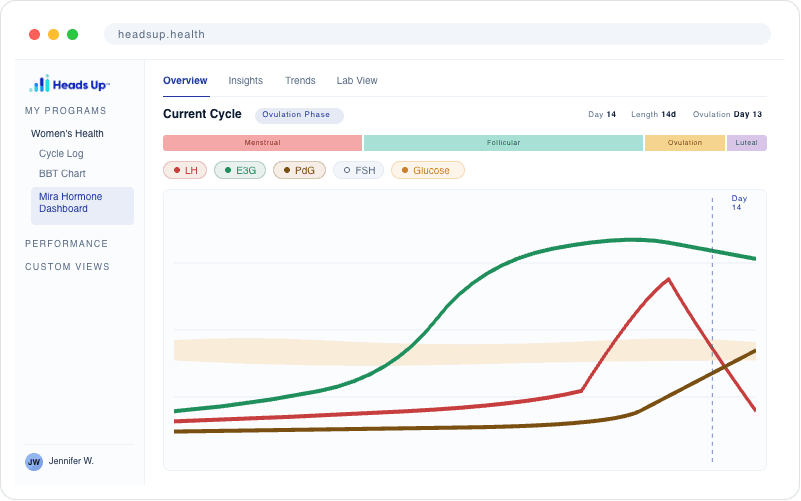
Overview — current cycle with hormones overlaid across phases.

Featured Speaker
Rose MacKenzie, BSN, RN, CEN
Clinical Manager, Mira
Rose helps healthcare professionals and fertility-awareness educators successfully implement Mira in their practices. Her clinical background spans leadership, restorative women’s health, and emergency medicine, and she supports providers through webinars, case reports, and one-on-one consultations.
With 10+ years as a fertility-awareness instructor (Marquette Method, Sympto-Thermal), she has guided women across regular and irregular cycles, postpartum amenorrhea, chemo-induced menopause, and perimenopause.
What you’ll learn
01
Why single time-point hormone testing falls short
Continuous data prevents the misinterpretation and incomplete treatment decisions that snapshot labs can’t avoid — especially in perimenopause and menopause.
02
How to interpret longitudinal hormone patterns
Distinguish ovulatory variability, hormone deficiency or excess states, and cycle irregularities using LH, E3G, PdG, and FSH trends.
03
Improve diagnostic timing and treatment precision
More accurate mid-luteal testing, contextual interpretation of lab results, and adjusting interventions based on pattern recognition.
04
FSH as a longitudinal risk marker
How tracking FSH trends over time supports both symptom management and broader health risk assessment.
05
See the Mira × Heads Up integration live
How continuous at-home hormone data flows directly into your clinical workflow alongside labs and wearables.
Quick recap
Rose MacKenzie, Clinical Manager at Mira, presents on the limitations of fragmented, single-point hormone testing and the clinical impact of continuous, longitudinal hormone data. Rose walks through real patient cases — including a perimenopausal patient with shifting serum values, a PCOS patient with non-ovulatory LH surges, and an HRT initiation case — demonstrating how context-rich data changes diagnostic accuracy, treatment timing, and patient outcomes. Alex Smith from the Heads Up product team then demos how Mira data flows into Heads Up alongside labs, CGM, and wearable data in a single longitudinal view.
Summary
Why single-point hormone testing falls short
Rose opens by acknowledging the historical challenge clinicians face with hormone evaluation: relying on patient history, single snapshot serum labs, or fragmented patient self-tracking. She explains the shift from “1D or 2D” hormone snapshots to continuous, daily hormone data — measured at home through a simple urine test that captures E2, LH, FSH, and the metabolite of progesterone (PdG) over an entire cycle. The data flows automatically from the Mira device to the patient’s app, and from there into the Heads Up dashboard, where it sits alongside lab work, wearables, and clinical notes.
What a normal cycle actually looks like
Rose walks through the visual pattern of a healthy cycle — rising estrogen toward ovulation, the coordinated LH/FSH surge signaling brain-to-ovary communication, and the progesterone rise confirming the corpus luteum has formed. Without continuous data, clinicians are often making assumptions about what’s happening between lab draws — and those assumptions can lead to treatment decisions based on incomplete information.
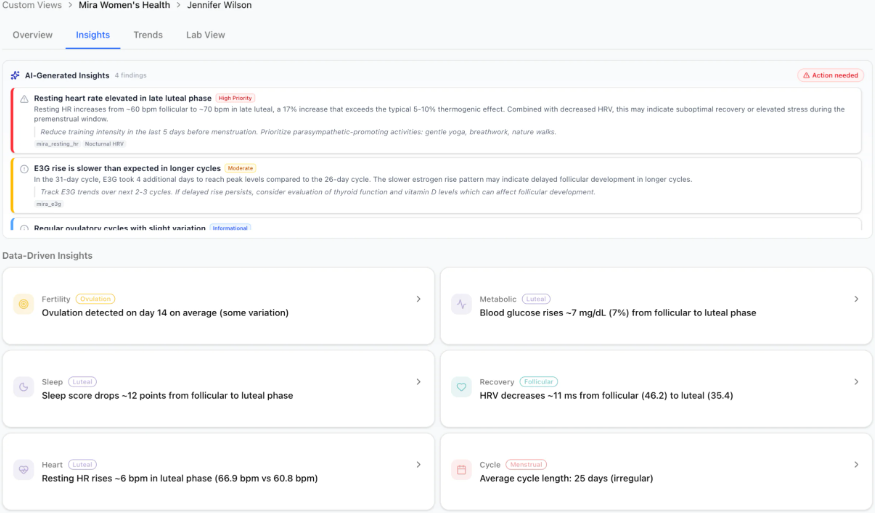
Insights — prioritized findings and data-driven summaries across systems.
Case 1: The perimenopausal patient with “normal” labs
Rose presents a 45-year-old patient with irregular cycles whose serum values varied dramatically depending on which day she happened to visit the lab. Within a single month, the same patient showed both low estrogen with high FSH and three weeks of high estrogen with low FSH — meaning a single random draw could yield completely different clinical interpretations. With continuous Mira data providing the context, those serum values suddenly become useful clinical information rather than confusing outliers.
Case 2: The PCOS patient and non-ovulatory LH surges
A patient with PCOS shows an attempt to ovulate that failed (estrogen rise + LH surge with no progesterone follow-through), followed by a successful ovulatory event later in the cycle. Without continuous data, a clinician would only see the second event and miss critical information about ovulation timing. For a fertility patient, knowing when ovulation actually occurred — versus when it appeared to occur — changes everything about timing intercourse, interpreting pregnancy tests, and understanding why a cycle “didn’t work.”
Case 3: HRT initiation and reading treatment response
Rose demonstrates how to interpret hormone data when a patient begins HRT — and importantly, how to recognize when a patient is “stacking” their own endogenous estrogen on top of HRT. Different forms of HRT (patch, gel, oral progesterone) create distinct patterns in the data, and reading those patterns correctly helps clinicians titrate dosing and identify when symptoms may be related to dosing timing rather than the medication itself.
The bigger picture: context matters
Throughout the session, Rose returns to a central theme: a single lab result is only as useful as the context surrounding it. Continuous hormone data provides that context, transforming what was previously a guess into a clinical conversation grounded in pattern recognition. When combined with labs, wearables, and symptom tracking — all visible in one place through Heads Up — clinicians have what they need to move from reactive symptom management to proactive, individualized care.
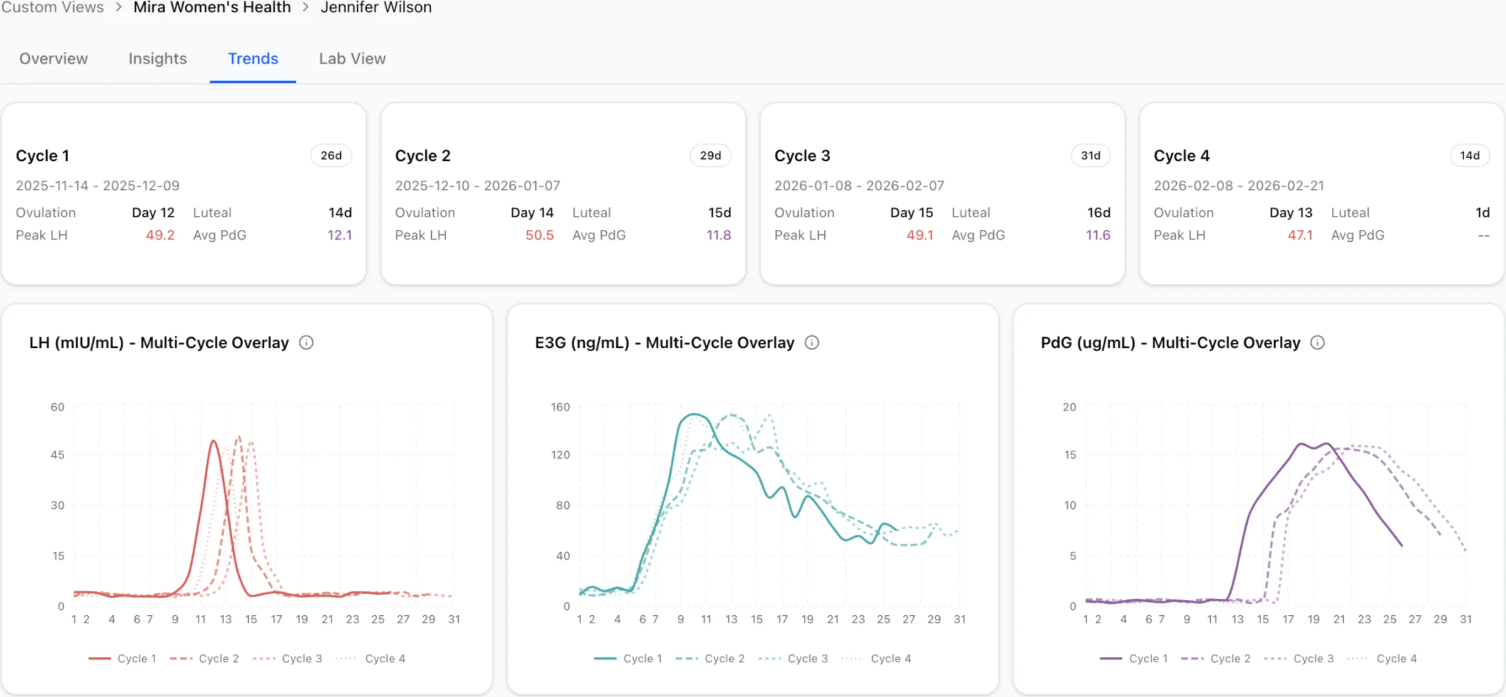
Trends — multi-cycle overlays of LH, E3G, and PdG side by side.
“If you have no Mira data, no longitudinal hormone data, then really, we are guessing more than we should be.“
Webinar resources
Designed for: functional and integrative medicine clinicians, longevity and concierge practices, reproductive endocrinologists, and women’s health programs working with longitudinal patient data.
Next steps
Ready to see your data layer and AI layer working together? Book a 30-minute mapping session to design your pilot — including hormone data, wearables, labs, and the AI workflow on top.
Book a 30-minute mapping session
We’ll map your current data sources, identify the highest-leverage AI workflows for your practice, and outline a pilot — including success metrics.