Protected: Episode 84 – Healing From Within: Functional Primary Care, Peptide Therapy & the Science of Salutogenesis with Dr. David Tusek of Cloud Medical
Password Protected
To view this protected post, enter the password below:

To view this protected post, enter the password below:
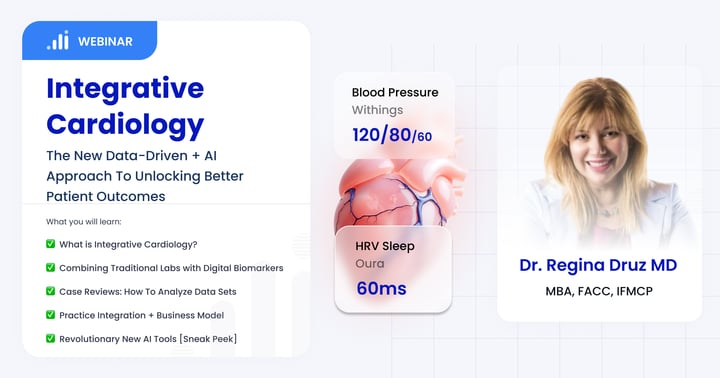
Dr. Regina Druz MD, MBA, FACC, IFMCP
Integrative cardiologist and founder of Holistic Heart Centers, a leader in precision cardiology programs that unite genomics, functional medicine, and digital health.
Dr. Regina Druz, MD, MBA, MS, FACC is an integrative cardiologist, physician executive, and digital health entrepreneur. She is the CEO and founder of Holistic Heart Centers, a precision medicine platform for heart health optimization and longevity. Dr. Druz created Fit in Your GENES®, a proprietary program that applies genomics and functional medicine to improve cardiovascular health and vascular aging.
A graduate of Weill Cornell Medical College, she also holds an Executive MBA and an MS in Health Policy from Cornell University. Board-certified in cardiology and certified in functional medicine, Dr. Druz previously served as National Director of Cardiology for a leading value-based care organization. She is a national and international speaker and podcaster, and enjoys traveling with her family.
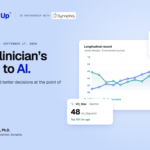
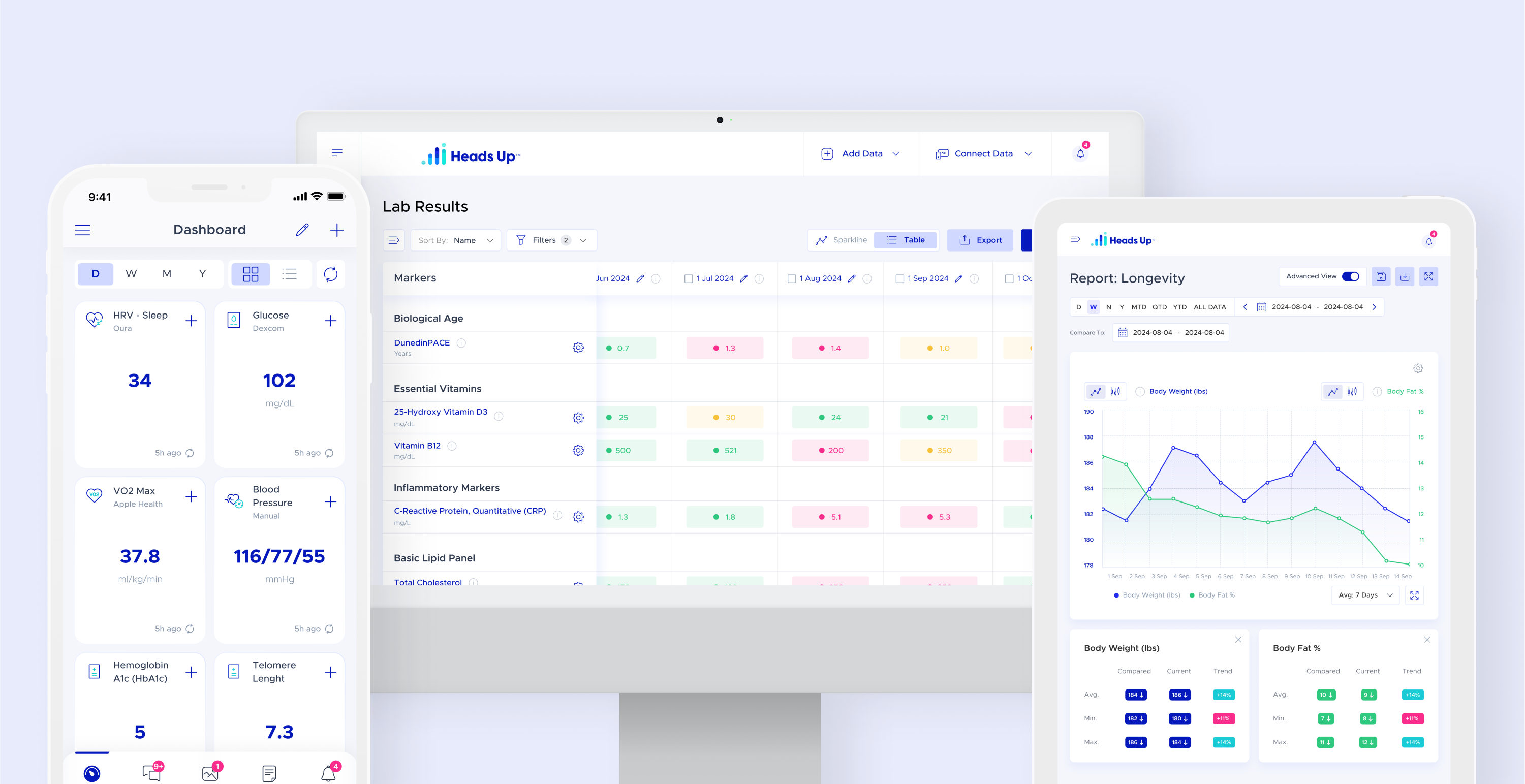
Discover how world-class integrative cardiologist, Dr. Regina Druz, utilizes longitudinal labs, continuous digital biomarkers, and AI to personalize treatment plans, enhance engagement, improve outcomes, and run a more profitable practice.
Learn how modern integrative cardiology works when labs, wearables, and AI function as one workflow. We will clarify when labs are important, which digital biomarkers to monitor, and how to combine both for precision care.
The webinar featured Dr. Regina, a functional medicine certified physician, who presented on Holistic Heart Centers and their precision cardiology approach focused on heart health optimization and longevity. She discussed the integration of diagnostics, labs, and wearables through the Heads Up platform and introduced digital biomarkers as key data points for assessing patient health trajectories. The presentation covered the importance of prevention in cardiovascular health, the role of integrative cardiology, and the use of medical-grade genetic data in assessing cardiovascular risk, and concluding with a demonstration of digital biomarkers in clinical practice.
David welcomed Dr. Regina to the webinar, highlighting her expertise in integrative cardiology and her contributions to previous webinars. Dr. Regina discussed the integration of diagnostics, labs, and wearables through the Heads Up platform, which synthesizes fragmented data to provide actionable insights for practitioners and patients. The webinar will conclude with a summary Q&A session and the announcement of giveaway winners.
Precision Cardiology and Digital Biomarkers
Dr. Regina, a functional medicine certified physician, presented on Holistic Heart Centers, a precision cardiology practice focused on heart health optimization and longevity. She discussed the importance of prevention in cardiovascular health and introduced digital biomarkers, which are data points collected from wearables and other devices that can provide insights into a patient’s health trajectory. Dr. Regina explained the difference between disease management and health optimization in cardiology, emphasizing the need for a new toolkit to guide patient health in the latter. She also highlighted the role of integrative cardiology and shared real patient cases to demonstrate the potential of digital biomarkers in improving patient care.
Integrative Cardiology: Precision and Personalization
The discussion focused on integrative cardiology, a framework that combines precision medicine with personalized lifestyle and therapeutic interventions to address residual cardiovascular risk beyond conventional treatments. The MI3 (Metabolic, Inflammatory, Immune, and Infectious) framework was introduced as a comprehensive approach to assess patients’ health across multiple domains, including hereditary predispositions, hormonal balance, and stress patterns. The speaker emphasized the importance of structured programs and digital biomarkers in documenting patient progress, while highlighting the need for a science-enhanced, data-driven approach to integrative cardiology.
Genetic Data for Cardiovascular Risk
Regina explained the use of medical-grade genetic data, including monogenic and polygenic scores, to assess cardiovascular risk. She highlighted that while large-effect genetic variants for conditions like familial hypercholesterolemia are rare, smaller genetic variants are more common and can contribute significantly to risk. Regina emphasized the importance of transitioning from known cardiovascular risk factors to identifying new patterns and strategies through data-driven approaches, including digital biomarkers and AI-powered decision support. She also discussed the challenges of insurance reimbursement for these advanced diagnostic tools and suggested alternative, more affordable options through direct purchasing.
Genetic and Biomarker Insights for LP(a)
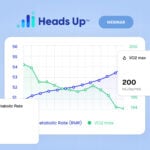
Dr. Regina discussed the genetic component of LP(a), noting that 90% is genetic. She addressed HRT in women with a positive family history of CBD, emphasizing risk management and the importance of addressing cardiometabolic factors. Dr. Regina also explained the role of Ripatha, a PCSK9 inhibitor, in reducing LDL cholesterol and its potential impact on LP(a). She highlighted two digital biomarkers, metabolic age and vascular age, which can help assess biological aging and cardiovascular risk beyond chronological age. These measurements can be influenced by interventions such as physical activity and nutrition.
Digital Biomarkers in Clinical Practice
Regina presented on integrating digital biomarkers into clinical practice, focusing on metabolic and vascular age assessments using wearable devices like Withings scales. She demonstrated how to analyze patient data to track improvements and identify areas needing attention, such as sleep quality and lifestyle factors. The discussion covered the limitations and potential of digital biomarkers, emphasizing the importance of synthesizing traditional and digital data for comprehensive patient care. David and Angela announced giveaway winners and encouraged participants to book demos to learn more about implementing these tools in their practices.
“We are a precision cardiology practice focused on heart health optimization and longevity and Heads Up has been quite instrumental in terms of building our workflows and giving us a line of sight to work with multiple patients”

Ready to see your data layer and AI layer working together?

Clinicians across integrative, functional, concierge and longevity medicine work with patients who present with persistent inflammation, unexplained symptoms and patterns that do not resolve with standard protocols. In many cases, the question is not whether inflammation is present. It is what sparked it in the first place.
During Biohackers World in Los Angeles, we spoke with Kashif Khan, founder of The DNA Company, about why detoxification and genetic individuality play a much larger role in root cause medicine than most patients and clinicians realize.
Below is a concise overview of his perspective and the key takeaways for health professionals.
For most patients, inflammation becomes the central theme in their clinical picture. It affects energy, cognition, hormone balance, cardiovascular health and long term aging. Khan points out that inflammation itself is only the surface level signal. The real clinical question is what started the inflammatory process.
Many patients arrive with high motivation, good lifestyle habits and strong adherence. Even so, they continue to experience chronic inflammation. This is often a sign that something upstream, such as detox burden, may not have been fully explored.
Individuals vary in how they respond to environmental exposures. Diet, stress and behavior matter, but so does the body’s built in ability to process and clear toxins. Khan notes that some people have strong biological defenses, while others have subtle genetic variations that make them more sensitive.
This means two patients with similar routines and environments can experience very different inflammatory responses. One may remain stable. The other may struggle with recurring symptoms that seem disconnected at first glance.
Understanding these differences helps clinicians better interpret why inflammation persists even when the patient appears to be doing everything correctly.
Khan highlights several testing paths that can help clarify detox capacity and underlying vulnerabilities.
• Functional genomic testing
• Full genome sequencing for deeper insight
• Condition specific genetic panels for unusual or unexplained cases
Each test type serves a different purpose. The goal is not to test broadly. It is to match the test to the clinical question. When clinicians understand the patient’s individual biology, they can connect upstream causes to downstream symptoms with far greater accuracy.
For practitioners in functional, concierge and longevity medicine, the message is straightforward. Chronic inflammation is rarely the starting point. It is a signal that the body is responding to an unaddressed burden. Detoxification challenges are one potential cause.
When clinicians can identify whether detox capacity is strong or vulnerable, they can guide patients with more precision and reduce the trial and error that often prolongs recovery.

The complete conversation with Kashif Khan is linked above. It is a short, high value look at how genetic individuality shapes detoxification, inflammation and clinical decision making.
This perspective offers a practical way to strengthen root cause assessment and support better outcomes for patients who remain difficult to diagnose or slow to improve.
Get started with by scheduling custom demo with one of our specialists to see the difference Heads Up can make in your practice. Schedule your demo and discovery call here.
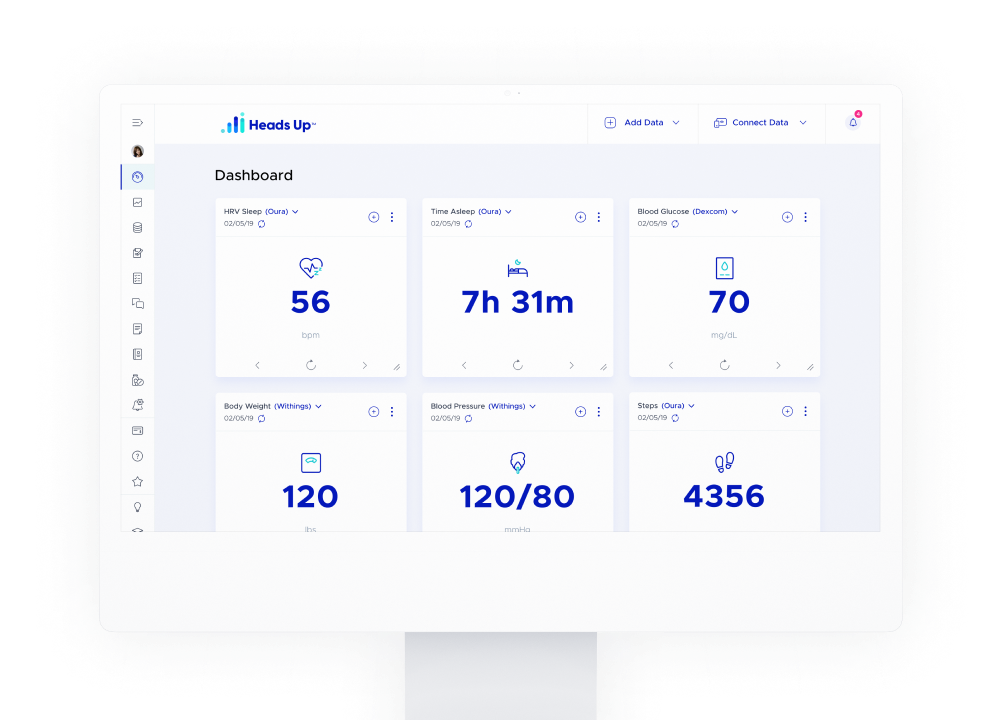
Synchronize your clients’ medical records, labs, wearables, apps, and more into Heads Up for better outcomes. Sign Up now for a free starter account!
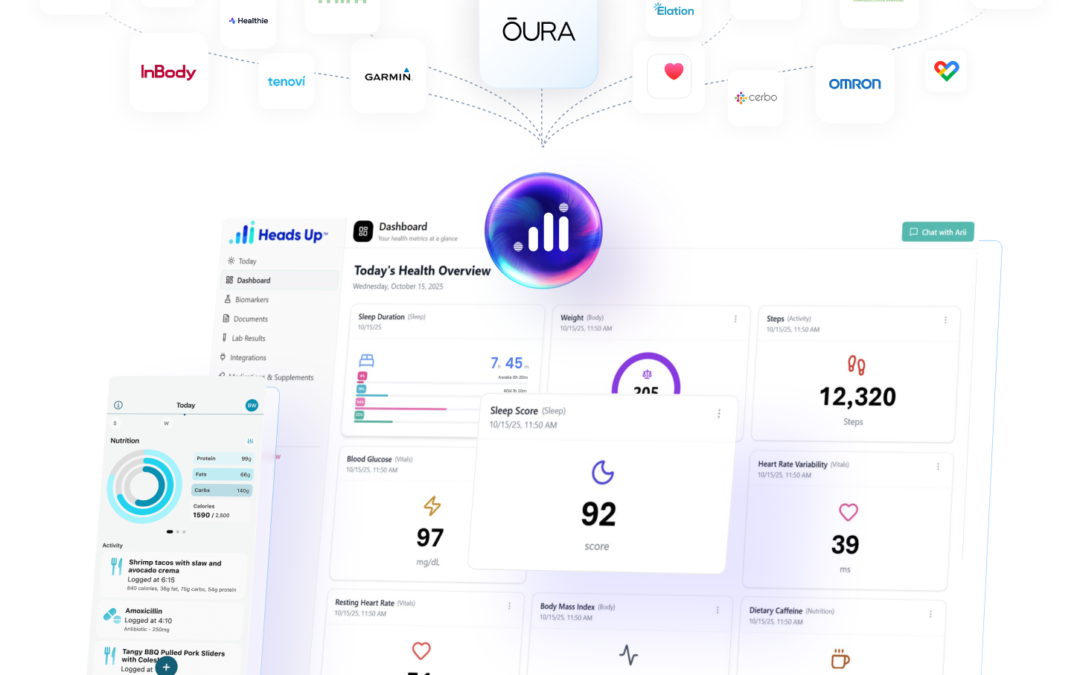
Artificial intelligence in clinical practice is finally reaching a meaningful inflection point, not through flashy black-box algorithms, but through pragmatic tools that make data useful in real time. Heads Up Health’s newest AI-powered features move in exactly this direction: transforming how clinicians see, reason about, and act on their patients’ data.
These capabilities now include:
AI nutrition tracking: Upload a meal photo, and AI calculates the full macro- and micronutrient breakdown automatically.
AI health data chat: Interactively explore correlations, test hypotheses, and visualize multi-source health data trends.
AI lab parsing: Instantly convert raw lab reports into structured, analyzable data.
Comprehensive lifestyle tracking: Aggregate vitals, sleep, body composition, activity, and stress metrics from leading wearables.
Let’s examine what this means for three practice models driving the longevity revolution.
The core challenge in longevity medicine isn’t collecting more data, it’s integrating it meaningfully across time. A patient may bring genomic panels, advanced lipid profiles, Oura Ring metrics, and continuous glucose data, but without an analytic layer, these remain disconnected streams.
AI-enabled integration solves this.
By automatically structuring lab data and correlating it with wearable metrics, you can identify long-horizon patterns such as:
rising vascular age despite stable cholesterol;
persistent HRV suppression tied to micronutrient depletion;
subtle pre-inflammatory signals following sleep debt cycles.
The result: earlier detection of biological drift before pathology manifests.
Longevity clinicians gain a unified system that supports hypothesis-driven practice, where AI proposes correlations and you decide which to test clinically.
Concierge physicians operate where experience, speed, and service define value. Time saved in data review directly translates into higher patient satisfaction and stronger margins.
AI now automates what used to take hours.
It parses PDF labs into standardized tables and graphs instantly.
It produces nutrition analytics from a photo, no manual logging required.
It flags physiological outliers (e.g., HRV or resting HR deviation) before the patient notices symptoms.
From an operational perspective, this reduces administrative burden and enhances the personalized touch your patients pay for. Every insight becomes deliverable: “Your sleep depth improved 14% after last month’s magnesium optimization,” supported by concrete visuals.
In a crowded concierge market, offering AI-enhanced continuous optimization isn’t a gimmick, it’s differentiation. The same infrastructure that saves you hours also gives patients proof of measurable progress, improving retention and referral rates.
Functional medicine thrives on discovering root causes across interconnected systems, but the manual correlation of labs, diet, and lifestyle markers has always been limiting.
AI expands that analytical reach exponentially.
Upload comprehensive lab panels; the system standardizes and cross-indexes them with lifestyle data.
Query directly: “How does micronutrient deficiency trend with low HRV episodes?”
The AI responds with visual correlation maps, revealing multi-variable interactions that would take hours to calculate manually.
This capability aligns perfectly with systems biology: it doesn’t replace practitioner judgment, it amplifies it by surfacing complex relationships hidden in longitudinal data.
The next stage of functional medicine will not be more testing, it will be better reasoning over the tests we already run. AI makes that reasoning immediate and evidence-linked.
Across all three models, longevity, concierge, and functional medicine, the benefit is the same: precision, efficiency, and deeper patient engagement.
| Challenge | Traditional Workflow | AI-Enabled Outcome |
|---|---|---|
| Data overload from wearables & labs | Fragmented review | Unified dashboards & trend alerts |
| Manual chart prep | 1–2 hours per visit | Instant structured data |
| Nutrition tracking | Inaccurate or absent | Photo-based micronutrient analysis |
| Correlation analysis | Requires external tools | Chat-based AI reasoning |
| Patient engagement | Episodic | Continuous, data-driven dialogue |
The next decade of healthcare will be defined by continuous data loops: sensing, analyzing, and adapting in real time. Heads Up Health’s AI engine marks a decisive step toward that future. It delivers clinical intelligence at the point of insight, empowering providers to spend less time extracting data and more time applying it.
For longevity, concierge, and functional medicine practices ready to move from reactive data review to proactive intelligence, the message is clear:
The AI revolution in personalized medicine is already here, inside your Heads Up Health dashboard.
“Heads Up provides a system to integrate all of the different data that you need to really deliver practice-based outcomes…“
Get started with by scheduling custom demo with one of our specialists to see the difference Heads Up can make in your practice. Schedule your demo and discovery call here.
Synchronize your clients’ medical records, labs, wearables, apps, and more into Heads Up for better outcomes. Sign Up now for a free starter account!

“Nobody wants to be really, really old with no purpose.”
That single line from Anti-Retirement Club founder Curtis Estes captures the heart of a growing longevity movement that goes far beyond lab data and health metrics.
In a short interview, Curtis explains how the Anti-Retirement Club began just two years ago with a simple mission: to help people live younger, longer. What started as a few local gatherings in Los Angeles has now become a global community, uniting medical experts, longevity tech innovators, and everyday individuals who share one goal: to extend not just lifespan, but healthspan.
The club’s events bring together MDs, PhDs, and CEOs from across the longevity and biotech fields. Yet, as Curtis explains, it isn’t only for practitioners.
“It’s primarily for the curious like me. We bring in the practitioners to educate our community, but it’s open to anyone who wants to learn.”
This balance between expert insight and community curiosity creates a rare space, one where research and real-life experience meet. For health professionals, it’s a reminder that education and empowerment are just as critical to long-term outcomes as any intervention or protocol.
Curtis outlines three simple but powerful pillars that guide the Anti-Retirement Club’s work:
Together, these pillars form a framework that integrates body, mind, and meaning, something both clinicians and individuals can apply in their own health journeys.
For those in concierge, functional, and longevity medicine, Curtis’ message offers more than inspiration. It’s a blueprint for what patients increasingly seek: a sense of purpose, belonging, and agency in their own health outcomes.
Practices that weave community connection and financial wellbeing into their approach can help patients achieve results that extend beyond the lab: stronger adherence, greater resilience, and longer, healthier lives.
Whether you’re a clinician helping others optimize their health or someone exploring the future of your own longevity, the Anti-Retirement Club offers a reminder that aging well isn’t about resisting time. It’s about redefining it.
Get started with by scheduling custom demo with one of our specialists to see the difference Heads Up can make in your practice. Schedule your demo and discovery call here.
Synchronize your clients’ medical records, labs, wearables, apps, and more into Heads Up for better outcomes. Sign Up now for a free starter account!

At the latest health and biohacking event, we had the chance to connect with Rowena Gates of Eng3, the company behind the NanoVi device. When asked about her favorite biohack right now, her answer was refreshingly simple: breathwork.
“I love the amazing things you can do with your own breath. I love the price point — it’s free.”
She explained how she tailors her practice throughout the day. Gentle, restorative breathing helps her wind down at night and get back to sleep. In the morning, she uses faster, more stimulating techniques (similar to the Wim Hof method) to energize her body and mind.
In a community driven by innovation and data, it’s an important reminder that the body’s own systems are often the best starting point for healing and performance. Nervous system regulation, recovery, and energy balance are foundations that make every other intervention more effective, whether it’s red light therapy, HRV tracking, or peptide optimization.
Breathwork bridges that gap. It’s free, accessible, and can be practiced anywhere. For clinicians, encouraging patients to integrate intentional breathing techniques can improve stress resilience, sleep quality, and even treatment adherence.
We love seeing how leaders in the biohacker and longevity community blend high-tech tools with simple daily rituals.
? What foundational practice do you use or recommend to help clients regulate, recover, and recharge?
Get started with by scheduling custom demo with one of our specialists to see the difference Heads Up can make in your practice. Schedule your demo and discovery call here.
Synchronize your clients’ medical records, labs, wearables, apps, and more into Heads Up for better outcomes. Sign Up now for a free starter account!